Showing posts with label atari history. Show all posts

Friday, October 20, 2006

Pong TV Game - History

The paleolithic ‘pong’
in the beginning, there was nothing. well, actually, there was
pinball, some shooting gallery games, a few nickel peep-show
machines and those mechanical genies that would guess your
weight and give a glimpse of your future. but it was probably
pretty hard trying to beat your buddies at who weighs less.
(there was bell, there was edison, there was fermi. and then there was higinbotham)

---
'tennis for two' on an oscilloscope
working at brookhaven national laboratory, a us nuclear research
lab in upton, new york, william a. higinbotham, a chain-smoking,
fun-loving character and self-confessed pinball player, wants to
develop an open house exhibit at bnl that will entertain people as
they learn. his idea is to use a small analog computer in the lab to
graph and display the trajectory of a moving ball on an oscilloscope,
with which users can interact.
missile trajectory plotting is one of the specialties of computers at
this time, the other being cryptography.
along with technical specialist robert v. dvorak who actually
assembles the device, to create in three weeks the game system they
name tennis for two, and it debuts with other exhibits in the
brookhaven gymnasium at the next open house in october 1958.
in the rudimentary side-view tennis game, the ball bounces off a long
horizontal line at the bottom of the oscilloscope, and there is a small
vertical line in the centre to represent the net.
the game was simple, but fun to play, and its charm was infectious.
http://www.pong-story.com/inventor.htm
brookhaven national laboratory - www.bnl.gov
tribute to william higinbotham, inventor of 'pong' - fas.org/cp/pong_fas.htm

---
'spacewar!'
at MIT circa 1961 there's a group of hard core computer nerds calling
themselves the tech model railroad club : wayne witanen and j. martin graetz,
along with 25 year-old steve russell, they develop the idea to pit two spaceships
with limited fuel supplies against each other in a missle duel. the program
becomes 'spacewar !', the world's first fully interactive videogame, with russell
as main programmer (1962).
two spaceships called the wedge and the needle, according to their shapes, are
rendered in rough outlined graphics. it causes a sensation at MIT's annual
science open house, and a scoring system must be introduced to limit people's time
at the control switches used to play. it is such a huge hit with the computer
community that copies are quickly spread around to other educational facilities in
the u.s. across the then burgeoning internet precursor ARPAnet.
and once again, just like willy higinbotham, russell doesn't seek to copyright or
patent his work. most likely because the system 'spacewar !' is running on is the
size of a refrigerator and costs us$120,000. due to its public domain status, the
game will end up being one of the most copied concepts in videogame history.
'spacewar !' ? http://lcs.www.media.mit.edu/groups/el/projects/spacewar

---
who really invented the videogame ?
in 1949, a young engineer named ralph baer, was given an assignment
to build a television set.
in 1966 with the help of bob tremblay and bob solomon they are
ready to demonstrate a system that allows spots to be moved around
on a tv screen. in january of 1967 baer puts technician bill harrison
to work to build the first multi-game unit. it plays 'chase' games, has a
'light gun' and a variety of other simple games. they call the system the
‘home tv game’. in early 1968 baer files for the first videogame patent,
and by the end of that year they again demonstrate the system,
capable of switching between ping-pong, volleyball, handball, hockey
and even several shooting games to be used with a newly designed
‘light-gun’.
during many years of litigation defending his patent, baer learns of
higinbotham's creation, and he describes it as a simple, oscilloscope-
based ballistics demonstration.
unfortunately, the man at the centre of this controversy cannot speak for
himself: william higinbotham, owner of 20 patents concerning electronic
circuits, passes away on november 10, 1995, at the age of 84.
after further developing the system was released as the first ever
commercially available home videogame to magnavox dealers as the
‘odyssey’ in may of 1972.
the graphics are so rudimentary that the system comes with a set of two
sizes of colour mylar overlays to put on the television screen to represent
the various playfields, including tennis and hockey.

---
the arcade
in the footsteps of pioneers william higinbotham, ralph baer and steve russel
nolan bushnell, the zeus of the videogame industry, is about to create an
entire entertainment industry, which in a few short years will eclipse even the
80 year old movie business.
at 19 years old, he becomes convinced of the commercial viability of a videogame
like 'spacewar', if only the system that ran it could be scaled down from university
mainframes and into a more reasonably compact version. he begins an eight year
odyssey to do just that: produce an arcade version of 'spacewar'.
1971 bushnell leaves ampex to work on the computer space game full time and
when he finally completes it that year he finds a buyer in nutting associates,
a manufacturer of coin-op trivia games. 1,500 of the units are built, with a futuristic
design and fiberglass cabinet, but the game does not sell well.
bushnell comes to the conclusion that the procedures of using various buttons for
the thrusting and rotating of the ships are just too complicated for half-pissed bar
patrons to comprehend. he becomes convinced that any successful video arcade
game has to be extremely easy to understand from the get-go.
at least the futuristic fibreglass cabinet is a hit...

---
'pong' released
bushnell, cofounder of atari in 1972 (a term from the japanese game go, whose
meaning is equivalent to "check" in chess.) bushnell hires al alcorn to program
games.
since alcorn is inexperienced, bushnell has him program a simple video tennis
game as an exercise. they call the game 'pong', for two reasons:
1) 'pong' is the sound the game makes when the ball hits a paddle or side of the
screen, and
2) the name 'ping-pong' is already copyrighted. 'pong' is but a polished variant
of the game willie higinbotham displayed on his oscilloscope.

---
ROM chips
now the arcade is about to get a whole lot more crowded, between 1971 and 1973,
30 videogames are produced for the arcade by 11 manufacturers.
in 1974 the company kee games, headed by joe keenan releases 'tank',
designed by scott bristow. gameplay consists of two tanks facing off in a maze,
while trying to avoid land mines scattered about. the game breaks new technical
ground by incorporating ROM chips to hold graphics memory, enabling it to display
more complicated detail on-screen than the simple blocks of 'pong'.
'tank' becomes the biggest hit of 1974, kee and atari 'merge' back into
one company.

---
'pong' is a tv based game
in 1974 atari employees bob brown and harold lee propose a home version of 'pong',
able to be hooked up to any tv set. retailers are skittish over the short life of magnavox's
tv-based 'odyssey' game and the system languishes in the atari labs.
in 1975 they cut a deal to sell the system under the sears tele-games label.
the order is for 150,000 units. bushnell has nowhere near the facilities to produce that
many in the time sears wants them, so he taps a venture capitalist for a $10 million
line-of-credit to expand. by christmas, atari's US$100 home 'pong' console becomes sears
biggest selling item, with reports of people waiting outside stores for hours to get one.
and once again dozens of manufacturers swarm out with myriad versions of home 'pong'
games. almost all of these machines are based on the new 'pong-on-a-chip' circuit
developed by general instruments.

Sunday, October 15, 2006

Specifications of Atari Jaguar


A. Physical dimensions:

Size: 9.5" x 10" x 2.5"
Controls: Power on/off
Display: Programmable screen resolution. Horizontal resolution is
dependent on the amount of scanline buffer space given to the
"Tom" graphics processor. Maximum vertical resolution varies
according to the refresh rate (NTSC or PAL). Reportedly, a
stock Jaguar (without additional memory) running NTSC can
display up to 576 rows of pixels.
24-bit "True Color" display with 16,777,216 colors
simultaneously (additional 8 bits of supplimental graphics
data support possible)
Multiple-resolution, multiple-color depth objects (monochrome,
2-bit, 4-bit, 8-bit, 16-bit, 24-bit) can be used
simultaneously
Ports: Cartridge slot/expansion port (32 bits)
RF video output
Video edge connector (video/audio output)
(supports NTSC and PAL; provides S-Video, Composite, RGB
outputs, accessible by optional add-on connector)
Two controller ports
Digital Signal Processor port (includes high-speed synchronous
serial input/output)
Controllers: Eight-directional joypad
Size 6.25" x 5" x 1.6", cord 7 feet
Three fire buttons (A, B, C)
Pause and Option buttons
12-key keypad (accepts game-specific overlays)

The Jaguar has five processors which are contained in three chips. Two of
the chips are proprietary designs, nicknamed "Tom" and "Jerry". The third
chip is a standard Motorola 68000, and used as a coprocessor. Tom and
Jerry are built using an 0.5 micron silicon process. With proper
programming, all five processors can run in parallel.

- "Tom"
- 750,000 transistors, 208 pins
- Graphics Processing Unit (processor #1)
- 32-bit RISC architecture (32/64 processor)
- 64 registers of 32 bits wide
- Has access to all 64 bits of the system bus
- Can read 64 bits of data in one instruction
- Rated at 26.591 MIPS (million instructions per second)
- Runs at 26.591 MHz
- 4K bytes of zero wait-state internal SRAM
- Performs a wide range of high-speed graphic effects
- Programmable
- Object processor (processor #2)
- 64-bit RISC architecture
- 64-bit wide registers
- Programmable processor that can act as a variety of different video
architectures, such as a sprite engine, a pixel-mapped display, a
character-mapped system, and others.
- Blitter (processor #3)
- 64-bit RISC architecture
- 64-bit wide registers
- Performs high-speed logical operations
- Hardware support for Z-buffering and Gouraud shading
- DRAM memory controller
- 64 bits
- Accesses the DRAM directly

- "Jerry"
- 600,000 transistors, 144 pins
- Digital Signal Processor (processor #4)
- 32 bits (32-bit registers)
- Rated at 26.6 MIPS (million instructions per second)
- Runs at 26.6 MHz
- Same RISC core as the Graphics Processing Unit
- Not limited to sound generation
- 8K bytes of zero wait-state internal SRAM
- CD-quality sound (16-bit stereo)
- Number of sound channels limited by software
- Two DACs (stereo) convert digital data to analog sound signals
- Full stereo capabilities
- Wavetable synthesis, FM synthesis, FM Sample synthesis, and AM
synthesis
- A clock control block, incorporating timers, and a UART
- Joystick control

- Motorola 68000 (processor #5)
- Runs at 13.295MHz
- General purpose control processor

Communication is performed with a high speed 64-bit data bus, rated at
106.364 megabytes/second. The 68000 is only able to access 16 bits of
this bus at a time.

The Jaguar contains two megabytes (16 megabits) of fast page-mode DRAM,
in four chips with 512 K each. Game cartridges can support up to six
megabytes (48 megabits) of information, and can contain an EEPROM
(electrically erasable/programmable read-only memory) chip to save game
information and settings. Up to 100,000 writes can be performed with the
EEPROM; after that, future writes may not be saved (performance varies
widely, but 100,000 is a guaranteed minimum). Depending on use, this
limit should take from 10 to 50 years to reach.

The Jaguar uses 24-bit addressing, and is reportedly capable of accessing
data as follows:

Six megabytes cartridge ROM
Eight megabytes DRAM
Two megabytes miscellaneous/expansion

All of the processors can access the main DRAM memory area directly. The
Digital Signal Processor and the Graphics Processor can execute code out
of either their internal caches, or out of main memory. The only
limitations are that

(1) "jump" instructions in main memory have certain restrictions; the JMP
(unconditional jump) command is longword-aligned, while the JR
(jump-indexed-by-register) command must be either word- or longword-
aligned. And
(2) running out of the cache is much faster (up to four times faster) and
efficient.

Some believe that the inability to jump/branch in main memory makes the
main memory feature useless.

Swapping data between the caches and the main memory is a quick, low
overhead operation, and therefore the main memory is often used as "swap
space" for cache code. The RISC compiler included in the latest Jaguar
developer's kit produced code that transparently swaps code through the
cache. This effectively allowed developers write RISC code without
concern for the cache size limits.

Compressed cartridge data can be uncompressed in real-time, and ratios of
up to 14:1 have been cited. In theory, a Jaguar cartridge can store up to
84 megabytes (672 megabits) of data, though actual results will vary
widely (most often, images are compressed, while sound and code are not).
Compression is performed with BPEG, an enhanced JPEG image decompression
mechanism. BPEG supercedes the former JagPEG algorithm, working up to 10
times faster and with more flexibility.

Other Jaguar features:
- Support for ComLynx I/O for communications with the Atari Lynx hand-held
game system and networked multiconsole games (on DSP port, accessible
by optional add-on connector). Networking of up to 32 Jaguar units
available.
- The two controller ports can be expanded to support "dozens" of
controllers
- Digital and analog interfaces
- Keyboards, mice, and light guns are possible
- Expansion port allows connection to cable TV and other networks
- Digital Signal Processor port allows connection to modems and digital
audio peripherals (such as DAT players)
- One megabyte per second serial interface
- 9600 baud, RS-232 serial port (accessible with optional interface)
- General-purpose I/O bits via the cartridge port
- Can accomodate future expansions of different processor types, I/O
types, video types, and memory types and/or quantities.

The Jaguar Modem


The Jaguar Modem is a finished product that connects to the Jaguar's DSP port. It came equipped with a combination headphone-microphone headset so gamers could talk to one another while they played against each other. The modem got its power from the Jaguar's power supply and had two telephone jacks, a power switch and 2 LED lights (for power and data connection).
We tried out the modems with Ultra Vortek, the only game known to have code written into it for use with the Jaguar modem. We managed to connect at 19,200 at each end (the apparent maximum connect speed) and the game played beautifully. So much so that we were going at it for hours! There was nary a hitch in the game's speed, although the voice quality was slightly less than optimal.
The Jaguar voice modem is truly a work of art. Had games like Battlesphere, Doom, Iron Soldier II and others supported this device (not to mention being delivered on time), the modem may have provided powerful ammunition against rival videogame systems.

Atari Jaguar CD - Review - Console History


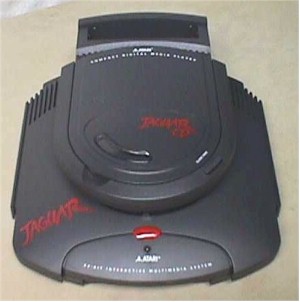
The Atari Jaguar CD or Jag CD was a CD-ROM peripheral for the Atari Jaguar video game console.
Late in the life span of the company, Atari released this long-promised CD-ROM unit. The device sat atop the Jaguar console, plugging into the cartridge slot, the physical design of the system sometimes compared to a toilet. The drive had its own cartridge slot to allow cartridge games to be played without removing the CD drive. There was a separate "Memory Track" cartridge for storing saved game position and high scores.
The Jaguar CD unit featured a double speed (2x) drive and built-in VLM (Virtual Light Machine) software. The VLM, which provided a sophisticated video light show when an audio CD was played in the machine, was as popular among buyers as the games themselves. Packaged with the drive were two games (Blue Lightning and Vid Grid), a music CD (Tempest 2000 soundtrack), and a Myst demo disc.
Jaguar CD games could include as much as 790MB of data, considerably more than conventional CD-ROMs. The designers chose to ignore established CD-ROM formats and instead created their own based on the audio CD format. While allowing for dramatically more storage on the disc and foiling casual piracy, the format only provided limited error correction.
The drive was manufactured for Atari by Phillips in the United States. The initial shipment was 20,000 units. Comments from Atari a few weeks after the unit was launched stated that the entire inventory had been sold, and that another batch would be ordered. However, with the JT Storage reverse takeover looming just a few months away, it is possible that those 20,000 drives were the only units ever produced.
While the ratio of CD to cartridge games is fairly low, the CD add-on unit has always held an interest to gamers. In particular, the value of the CD add-on has gone up dramatically in the past few years, mainly due to low supply. Also, it is now possible to (legally) download and burn several encrypted demos (Black Ice/White Noise, Native, Atomic) to play on an actual CD unit with no modification. Due to this, the homebrew sector is active with several titles in progress (Eerievale). However, a third-party cartridge (Protector SE, B&C's cart) is still required for unencrypted games (Painter).

History Of Atari


The trials and tribulations of Atari could fill a small book (and, in
fact, once did). To summarize VERY briefly, the history of Atari is as
follows:

1972 Atari Inc. founded by Nolan Bushnell from a $250 investment.
Pong arcade game becomes a smash sensation.
1976 Atari Inc. sold by Bushnell to Warner Inc. for $28 million.
1980 Atari Inc. posts record sales. $2 billion profits annually.
Atari occupies 80 offices in Sunnyvale, CA.
1983 Decline of video games and irresponsible spending by Atari Inc.
results in record losses ($536 million, up to $2 million
daily).
1984 Warner divides Atari Inc. Home division (Atari Corp.) is sold to
Jack Tramiel.
1985 Atari Corp. releases Atari ST home computer.
1989 Atari Corp. releases Atari Lynx, the world's first color
hand-held video game system (see the Atari Lynx FAQ).
1993 Atari Games becomes Time-Warner Interactive.
1993 Atari Corp. releases Atari Jaguar, the world's first 64-bit home
video game system.
1996 Time-Warner Interactive (Atari Games) sold to WMS.
1996 Atari Corp. announces reverse merger with JTS Corporation.
1996 Atari Corp. and JTS connsumate deal on July 31 1996.
1998 Hasbro acquires the rights to Atari Corp.'s name and properties
1999 Hasbro releases their rights to the Jaguar to the public; Atari
is reborn as their new home video game label.