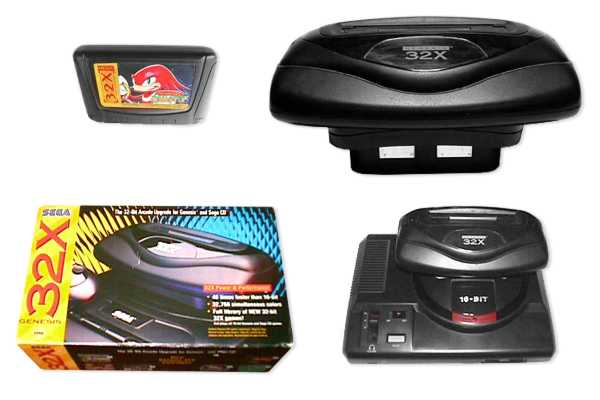
The idea for the 32X originally came from Sega of Japan and was handed to Sega of America to work on. SOA decided that it was better for the unit to be an upgrade to the existing Mega Drive rather than a separate console. This move would have the advantage of making the 32X more appealing to users who would rather upgrade their current hardware then buy an all-new standalone console. SOA went with the SOJ design plan to have twin 32-bit processors and a separate graphics processor. In November 1994, the 32X was released in the US, a month later in Japan (where it was called the Super 32X) and in January 1995 in Europe.
At first, the 32X was a success. Sega was unable to ship the 1 million units it had promised and ended up shipping about half of that to retailers because of slow production. Nevertheless, the 32X sold out in many areas and Genesis owners were keen to get their hands on it in time for Christmas. With a non-existent library of games and none bundled with the unit, consumers who had bought the 32X had to be patient for a while.
Things then started going down hill. Complaints started coming in about the the unit not being compatible with some older TVs, which prompted Sega to release an adaptor to rectify the problem, at a price of course. Another issue was the metallic clips, which had to be placed on both sides of the cartridge slot to protect it from electromagnetic interference. Apparently, many parents found it difficult to clip them on around the cartridge covers. I can't seem to believe that this was a major problem, but then again what do I know except for what I read.
A third factor was news coming in from Sega of Japan about the Saturn, which left gamers confused. Was the 32X the thing to have, or was it the Saturn, or maybe the Sega CD! Unsatisfied customers took back their 32X hardware and software to their stores and the 32X seemed to be in big trouble. Upcoming games were slowly cancelled and both Sega and retailers across the US realized that the 32X didn't have long to live. By the Christmas of 1995, the 32-bit console was dead and buried, with DarXide being the last game ever to be released for it. I personally have no memories of the 32X because I didn't own it until recently, but reading about how it was ultimately the beginning of Sega's decline as a hardware console company really makes me sad (and for some reason angry at Sony! Don't ask why)
The 32X retailed for $159. 27 games were released for the European 32X, 18 for the Japanese Super 32X and 39 for the American Sega 32X.
Technical Specs:
CPU: Two Hitachi 32-bit RISC processors at 23MHz/40MIPSCo-processors: Genesis 68000, Z80, VDP and 32X VDPRAM: 4Mb plus the Mega Drive RAMColors: 32,768 simultaneous colorsGraphics: RISC processors and dual frame buffers with rotation and scaling hardware supportPolygons: Renders up to 50,000 polygons per secondResolution: 320x224Sound: 2-channel stereo digital PCM (+12 channels of the Mega Drive)
At first, the 32X was a success. Sega was unable to ship the 1 million units it had promised and ended up shipping about half of that to retailers because of slow production. Nevertheless, the 32X sold out in many areas and Genesis owners were keen to get their hands on it in time for Christmas. With a non-existent library of games and none bundled with the unit, consumers who had bought the 32X had to be patient for a while.
Things then started going down hill. Complaints started coming in about the the unit not being compatible with some older TVs, which prompted Sega to release an adaptor to rectify the problem, at a price of course. Another issue was the metallic clips, which had to be placed on both sides of the cartridge slot to protect it from electromagnetic interference. Apparently, many parents found it difficult to clip them on around the cartridge covers. I can't seem to believe that this was a major problem, but then again what do I know except for what I read.
A third factor was news coming in from Sega of Japan about the Saturn, which left gamers confused. Was the 32X the thing to have, or was it the Saturn, or maybe the Sega CD! Unsatisfied customers took back their 32X hardware and software to their stores and the 32X seemed to be in big trouble. Upcoming games were slowly cancelled and both Sega and retailers across the US realized that the 32X didn't have long to live. By the Christmas of 1995, the 32-bit console was dead and buried, with DarXide being the last game ever to be released for it. I personally have no memories of the 32X because I didn't own it until recently, but reading about how it was ultimately the beginning of Sega's decline as a hardware console company really makes me sad (and for some reason angry at Sony! Don't ask why)
The 32X retailed for $159. 27 games were released for the European 32X, 18 for the Japanese Super 32X and 39 for the American Sega 32X.
Technical Specs:
CPU: Two Hitachi 32-bit RISC processors at 23MHz/40MIPSCo-processors: Genesis 68000, Z80, VDP and 32X VDPRAM: 4Mb plus the Mega Drive RAMColors: 32,768 simultaneous colorsGraphics: RISC processors and dual frame buffers with rotation and scaling hardware supportPolygons: Renders up to 50,000 polygons per secondResolution: 320x224Sound: 2-channel stereo digital PCM (+12 channels of the Mega Drive)


27 comments:
virtua fighter
developer sega
publisher Sega AM2
series virtua fighter
platforms arcade Sega Saturn
sega 32x
r- zone
genre fighting
arcade system sega model 1
arcade game not port to sega 32x by namco in 1995
tekken 2
developer namco
series tekken
platforms arcade PlayStation
genre fighting
arcade system Namco System 11
fighting vipers
developer sega
publisher Sega AM2
platforms arcade sega Saturn
genre fighting
arcade system sega model 2
cyberbots
developer capcom
publisher capcom
platforms arcade Sega Saturn
PlayStation
genre fighting
arcade system cps system 11
Atari
capcom
Nintendo
Sammy
sega
snk
Taito
fatal fury 3
developer snk
publisher snk
series fatal fury
platforms arcade Neo Geo
neo Geo cd
genre fighting
arcade system Neo Geo mvs
marvel super heroes
developer capcom
publisher capcom
series marvel vs. capcom
platforms arcade PlayStation Sega Saturn
genre fighting
arcade system cps system 11
Mortal Kombat 3
developer midway
series Mortal Kombat
platforms arcade PlayStation
sega Gênesis
super nes
genre fighting
arcade system midway x unit
mortal ultimate kombat 3
developer midway
series Mortal Kombat
platforms arcade Sega Saturn
super nes
genre fighting
arcade system midway wolf unit
street fighter alpha
developer Capcom
publisher capcom
series street fighter
platforms arcade PlayStation
Sega Saturn
genre fighting
arcade system cps system 11
soul edge
publishers namco
series soulcalibur
platforms arcade PlayStation
genre fighting
arcade system Namco System 11
virtua fighter 2
Virtua Cop 2
sky target
crypt killer
virtua fighter remix
sega rally
sega dreamcast
PlayStation 1
PlayStation 2
time crisis
developer namco
series time crisis
platforms arcade PlayStation
genre light gun shooter
arcade system Namco System 22
time crisis 2
developer namco
series time crisis
platforms arcade PlayStation 2
genre light gun shooter
arcade system Namco System 23
crisis zone
developer namco
series time crisis
platforms arcade PlayStation 2
genre light gun shooter
arcade system Namco System 23
Nintendo 64
game boy
game boy color
super nes
super famicom
nes
Atari 2600
Atari 2500
Atari 7800
Atari Jaguar
Atari Lynx
Atari falcon
Atari 8 bits
neo Geo
Neo Geo cd
game boy color
sailor moon
developer banpresto
platforms arcade sega game gear
sega Gênesis
genre beat em up
zombie raid
developer American Sammy
platforms arcade
genre light gun shooter
samurai showdown 3
developer snk
series samurai showdown
platforms arcade PlayStation
genre fighting
arcade system Neo Geo mvs
king of fighters 94
used to be made by snk corporation in 1994
port to arcade Neo Geo
tekken
developer namco
series tekken
platforms arcade PlayStation
genre fighting
arcade system Namco System 11
super street fighter 2 turbo
developer capcom
publisher capcom
series street fighter
platforms arcade dreamcast
3do
game boy advance
genre fighting
arcade system cps system 11
x- men children of the atom
developer capcom
series x-men
platforms arcade PlayStation Sega Saturn
ms dos
genre fighting
arcade system cps system 11
Daytona USA
used to be made by sega
port to Sega Saturn
Area 51
used to be made by Atari games in 1995
port to arcade PlayStation Sega Saturn
king of fighters 95 used to be made by snk corporation in 1995 port to arcade PlayStation game boy Neo Geo Neo Geo cd
Sega Saturn
Post a Comment